
Spite, Melancholy, Mourning
Three Sama Dilaut singing traditions and the end of reading

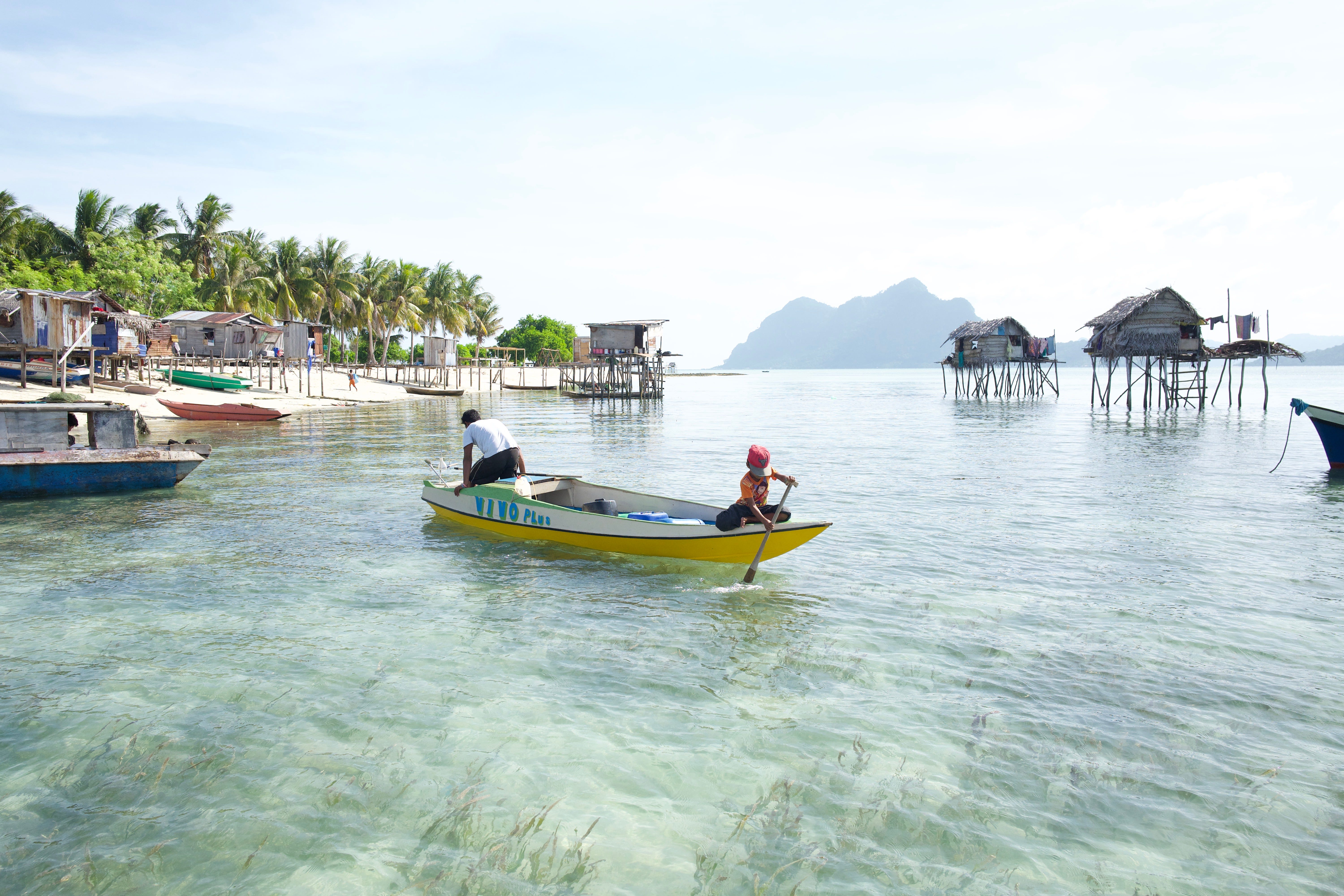
Sama Dilaut, also known as Bajau Laut — both names translate to “people of the sea” — are traditional sea nomads of Southeast Asia. They were once found all across the Coral Triangle, living in small-scale societies of boat-dwelling foragers, and are today concentrated in the Sulu and Celebes seas, along the maritime triborder of the Philippines, Malaysia, and Indonesia. Although they are being settled on land in all of these countries — a process of assimilation that began after World War II — for centuries Sama Dilaut lived exclusively on houseboats in coral shallows, where they developed an uncommonly rich song tradition.
In the 1960s, back when most Sama Dilaut still lived on the water, virtually every adult and child was a capable singer, conversant in many genres. There were genres for shark hunting, catching sea mantis, healing the sick, marriage, and childbirth. There were lullabies for children and romantic ballads called tenes-tenes, which were sung exclusively by teenagers. There were funerary songs called kalangan matai (“songs of the dead”) and haiku-like sailing songs called kalangan baliu (“songs of the wind”).
These songs followed recognizable melodies and structures but their lyrics were spontaneous. They functioned as improvised entertainment and news, as performance, and as technologies of social license, granting their singers freedom to indulge difficult emotions and discuss subjects that were taboo in everyday speech. Almost every outsider who has written about the Sama Dilaut describes them as peaceable and timid, historically victimized by more aggressive land-dwellers. (Most of the Sama Dilaut people I’ve met describe themselves in the same way today, as do the other Sama and Tausug people among whom they live.) If they faced aggression, they fled, having no social or political structures that could not survive disaggregation. Among themselves, direct conflict was rare. Songs were sanctioned spaces for conflict and confession.
The following three genres of songs were transcribed and translated by the mid-century anthropologist H. Arlo Nimmo, who lived in a moorage in Tawi-Tawi, in the southern Philippines, in the early 1960s.1 Anthropological records, we know, are never pure. Cultures don’t hold still for their portraits, and oral traditions are particularly slippery; they were never meant to be fixed to the page. In Orality and Literacy, his study of oral and literate cultures, Walter Ong writes that “song is the remembrance of songs sung,” but improvised songs are antipathetic to both memory and writing. A transcription of an improvised song is a shadow of a singular event, and so these are genres of shadows: The lyrics are shadows of passing thoughts just as any given name and year is the shadows of a unique, unrepeatable performance. They may obscure rather than illuminate, but here they are.
Lia-lia
Lia-lia are sung exclusively by small children. Nimmo describes then as “spite songs.” When children become angry with playmates or family members, they find a secluded spot and sing lia-lia to vent; singing affords them a freedom to disrespect adults that is otherwise forbidden. Parents usually pretend they can’t hear the songs, although children often make sure to sing where their parents will be able to listen to what they have to say.
Lia, lia, lia.
I am angry with you, mother.
You will not let me play on the beach.
Other children have good mothers who let them play on the beach.
But my mother does not like me.
I wish I had another mother.
I wish I could go away.(Bangsaria 1965)
Lia, lia, lia.
I do not like the children at this moorage.
Tomorrow I will go away from this moorage to Lu’uk Tulai.
My father is a handsome man;
He is better than the fathers of the other children here.
Tomorrow he will take me to Lu’uk Tulai,
Because I do not like the children here.(Kambar 1965)
Lia-lia. I am angry with you.
I remember my father, a handsome man.
Hear my song, my friend.(Maria 1965)
Kalangan Baliu
Kalangan baliu, or “songs of the wind,” are sung by men during idle hours on fishing and sailing trips, usually at night. They are melancholic vignettes, often expressed while alone or to a sailing partner on a moonlit lepa — the canonical Sama Dilaut houseboat — or, occasionally, across the water to a friend on another lepa within hearing range.
Changing, shifting winds,
Tell Salamdulila,
Do not forget me.(Enang 1967)
White sails.
Sailing from Kangan.
A smooth sea.(Anonymous 1966)
The whirling wind strikes the prow;
The flying wind.(Suluhani 1966)
White sails,
Sailing to Sitangkai.
Single file.(Masarani 1966)
O wind.
You blow the waves—and my heart—
into a thousand pieces.(Anonymous 1966)
Now blows the north wind.
Tell her the truth:
I never loved her.
My heart is always angry,
Like a ship on a rough sea.(Jalai 1967)
Kalangan Matai
Kalangan matai are “songs of the dead.” As soon as word of a death spreads through a Sama Dilaut moorage, neighbors crowd around the death boat while the deceased is bathed and wrapped in a white shroud. The body remains in the moorage overnight before it is taken to a burial island. During the night, mooragers sing songs to express their sorrow and flatter the deceased.
In 1966, a man, about thirty-five years old, died suddenly. His wife sang:
My father is dead.
My mother is dead.
My sister is dead.
My brother is dead.
And now my husband is dead.
How, then, can I live?(Abira 1966)
His mother sang:
You are gone now and I am alone.
But you are not alone.
With you in your grave are your father, brothers and sisters.
And soon I, too, shall join you.(Laiha 1966)
A cousin “with whom the deceased never got along,” Nimmo writes, sang:
You were the best fisherman.
Everyone in the moorage loved you.
I respected you more than any man I know.
You were a good father and husband.
Now you are gone, but I will see that your wife and children have fish.
You and I were like brothers.(Sawani 1966)
At another funeral, a man sang to a brother-in-law who was killed while fishing with dynamite, a common and dangerous pastime:
I will not stop using dynamite,
so I can soon be with you.(Samsalani 1966)
At another, a man sang to his dead wife:
Why are you so late?
You said you would come for me two days after your death.
Still, I wait.(Ganti 1966)
//
All of the Sama Dilaut singing traditions are in decline, if not functionally extinct. Some years ago, I spent a month traveling among moorages in the Sulu and Semporna archipelagos.2 Only once or twice did I witness performances of songs, or more often ritual dances (an equally elaborate tradition), and then only for my benefit as a curious outsider. The performers were all very old.
No tradition lasts forever, of course. It’s useless to mourn or pity their passing, but we still do, captive to the romantic myth that the moment just before our own was the right one, the most floridly expressive and correct. Those of us caught in what Claude Lévi-Strauss called “the toils of mechanized civilization” find it particularly easy to mourn the passing of traditions found in the exotic illiterate societies on our margins, and during anthropology’s mid-century heyday the main ethnographical register was melancholic. You find it on nearly every page of Tristes Tropiques:
Journeys, those magic caskets full of dreamlike promises, will never again yield up their treasures untarnished. A proliferating and overexcited civilization has broken the silence of the seas once and for all. The perfumes of the tropics and the pristine freshness of human beings have been corrupted by a busyness with dubious implications, which mortifies our desires and dooms us to acquire only contaminated memories.
No more pristine freshness for us. Mankind, Lévi-Strauss writes, “has opted for monoculture; it is in the process of creating a mass civilization, as beetroot is grown in the mass. Henceforth, man’s daily bill of fare will consist only of this one item.”
Contemporary anthropologists are more sensitive. Cultures are always changing, they say, and to lament change is essentializing, denying others the agency to determine their own collective future. What’s great about Tristes Tropiques, the reason it endures as literature in the face of the many “turns” anthropology has since taken, is that its lamentations are suffused with ironic awareness of this fact. Lévi-Strauss is self-aware enough to mock the melancholic mode as often as he indulges it, recognizing the low, pith-helmeted origins of his own sorrow:
Then, insidiously, illusion began to lay its snares. I wished I had lived in the days of real journeys, when it was still possible to see the full splendour of a spectacle that had not yet been blighted, polluted and spoilt; I wished I had not trodden that ground as myself, but as Bernier, Tavernier or Manucci did … Once embarked upon, this guessing game can continue indefinitely. When was the best time to see India? At what period would the study of the Brazilian savages have afforded the purest satisfaction, and revealed them in their least adulterated state?
It’s a guessing game I’ve heard lots of writers play. When would it be best to have written? When do I wish to have lived? Well, the 1960s, probably, most people say, when the New York Review of Books was God and Law, when Philip Roth topped the charts. When Gore Vidal and Susan Sontag were on television. Certainly before the Internet. Before TikTok. Most definitely before ChatGPT — during Claude L-S, before Claude. Back when people could read.
Like the nation-state, fossil fuels, and central banking, mass literacy is a historical anomaly, a blip in the history of the world. But as we ponder the end of reading, the end of literature, even the end of literacy itself, it’s often through our own improvised songs of spite, melancholy, and mourning. Rose Horowitch’s The Atlantic cover story “The End of Reading” covers all three.
More interesting, to me, is Sam Kriss’s Jacobin article “Reading is Magic,” which follows Ong, Marshall McLuhan, and others in recognizing the historical bizarreness of literacy, its peculiar madness. “Lewis Mumford called it the ‘general starvation of the mind,’ in which actual sensuous knowledge of the world is replaced by ‘mere literacy, the ability to read signs.’” It makes passing shadows seem permanent.3
Shadows move us, we can’t help it: obscure collections of names and images, long-forgotten confessions of discontent and desire. Some Sama Dilaut songs now seem pretty funny, particularly those addressed to sharks (“Your fin is handsome…come and take my gift”) and sea mantis (“Take my bait, Balu / Do not be ashamed / I already have your husband”). Others are sad or express emotions that defy translation. Tenes-tenes have a romantic flavor, and are close to contemporary pop songs in their adolescent yearning. Some are long reported narratives; others are short and dream-like. They all begin with a stock formation: “My song is of many interwoven colors.” “My song is of the many colors of the sail.”
Post-literacy will be strange, and maybe less colorful or interesting to me, just as beetroot is less colorful than the gardens of oral culture that preceded it. But when I catch myself in a po-faced state of spite and mourning, a kind of priggish superciliousness about “shrinking attention spans and declining comprehension,” I know that, insidiously, illusion has begun to lay its snares.
//
Nimmo, H. Arlo. Magosaha: An Ethnography of the Tawi-Tawi Sama Dilaut. 2001.
For my forthcoming book, which I will finish…soon.
See also my old post, “Burn after Writing.”
Lovely. I remember going behind our garage to sing “nobody likes me, everybody hates me, I guess I’ll eat worms …” which was in earshot of my parents. Worms! Our culture in the US never ever had the purity and clarity of the Sama Dilaut.